Table Of Content
Why Educational School Picnics Are Important
School picnics provide more than a break from classroom routines. When planned around educational objectives, they allow students to observe, ask questions, work together and experience concepts that may otherwise remain theoretical.
Agriculture is particularly valuable as a learning subject because it connects science, geography, biology, environmental studies, technology, economics and everyday life.
Students can explore questions such as:
Where does our food come from?
How do farmers prepare soil and grow crops?
Why is water management important in agriculture?
How are organic waste and animal dung reused?
What happens to crops after harvesting?
How do farmers store onions and other agricultural produce?
How do farming and animal husbandry support rural communities?
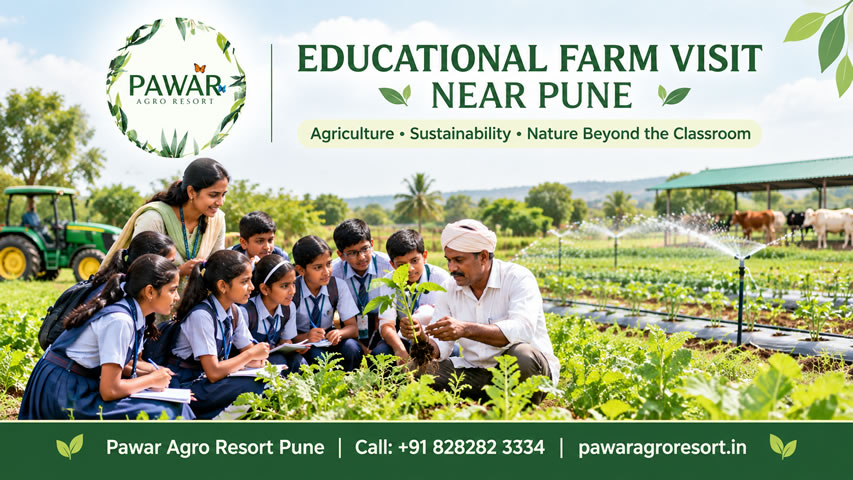
A school picnic at an agricultural resort near Pune can help students understand these connections through farm walks, observations and suitable demonstrations.
Why Choose Pawar Agro Resort for a School Picnic Near Pune?
Pawar Agro Resort is located on Nandur–Khamgaon Road, near Uruli Kanchan, approximately 30 km from Pune.
The resort’s approximately 20-acre property offers a natural setting for schools seeking a combination of outdoor recreation and agriculture-related learning.
Key features include:
Approximately 20 acres of green surroundings.
Farm walks and nature-based learning opportunities.
Opportunities to learn about agriculture and farming practices.
Exposure to dairy farming and rural life, subject to activity availability.
Topics such as irrigation, organic farming and vermicomposting.
A large green lawn for suitable group activities.
Vegetarian dining arrangements with a stated capacity of more than 500 students at a time.
Ample parking space, with bus arrangements to be confirmed.
A location accessible from Pune and surrounding areas.
For schools searching online for a school picnic place near Pune, an educational trip near Uruli Kanchan or a farm visit for students, Pawar Agro Resort is worth considering.
Agriculture and Farming Experiences for Students
Practical agricultural learning helps children understand the effort, knowledge and resources involved in producing food.
1. Soil Preparation and Crop Cultivation
Students can learn how farmers prepare fields before planting, why soil quality matters and how crop selection depends on factors such as climate, water availability and soil characteristics.
Teachers can connect the experience with classroom lessons in plant science and geography.
2. Water Irrigation Systems and Water Management
Water is essential for agriculture, but its availability can vary by season and location.
Students can explore irrigation concepts and understand how farmers deliver water to crops. Discussions can introduce water conservation, efficient irrigation and the importance of managing this valuable resource responsibly.
3. Mulching Paper and Crop Protection
Agricultural mulching is a technique used to cover the soil around plants. Depending on the material and application, mulch can help conserve moisture, suppress weeds and support crop management.
Students can learn why farmers choose different methods according to the crop and growing conditions.
4. Pest Control Techniques
Crop pests can affect plant health and agricultural productivity. Students can learn the basics of identifying crop problems and understanding pest management.
An educational discussion can introduce beneficial insects, preventive practices and integrated pest management.
5. Organic Farming Practices
Organic farming provides an opportunity to discuss soil health, organic inputs, composting and responsible agricultural practices.
Students can learn why farmers pay attention to soil fertility, biodiversity and the long-term condition of the land.
6. Onion Storage and Post-Harvest Management
Growing a crop is only one stage of agriculture. After harvesting, produce must be handled, transported and stored appropriately.
Onion storage offers a practical example of post-harvest management. Students can learn why ventilation, moisture management and suitable storage conditions are important in reducing spoilage.
This topic can also introduce food supply chains, agricultural markets and the work involved in bringing farm produce to consumers.
7. Hands-On Vermicompost Learning
Vermicomposting uses earthworms and microorganisms to help decompose suitable organic material into nutrient-rich compost.
Students can learn how organic waste can become a useful agricultural resource and how compost contributes to soil management.
This activity connects biology, waste management and sustainable farming.
Environmental and Sustainability Learning
Environmental awareness is an important part of modern education. An educational farm visit can demonstrate how natural resources, farming and waste management are interconnected.
Vermicompost and Waste Management
Students can explore how biodegradable waste can be processed into compost rather than unnecessarily discarded.
Biogas Plant and Renewable Energy
Biogas systems can use organic materials, including animal dung, to produce a fuel-rich gas. Students can learn about renewable energy, resource recovery and the potential uses of biogas in rural settings.
Natural Water Purification
Suitable demonstrations can introduce the basic principles of filtration and water treatment. Students should also understand that a simple filtration demonstration does not necessarily make water safe to drink.
Soil Conservation
Students can learn why soil erosion occurs and how vegetation and responsible land management can help protect the soil.
School Picnic At Pawar Agro Resort


Ecosystem Awareness and Nature Walks
Environmental awareness is an important part of modern education. An educational farm visit can demonstrate how natural resources, farming and waste management are interconnected.
Vermicompost and Waste Management
Students can explore how biodegradable waste can be processed into compost rather than unnecessarily discarded.
Biogas Plant and Renewable Energy
Biogas systems can use organic materials, including animal dung, to produce a fuel-rich gas. Students can learn about renewable energy, resource recovery and the potential uses of biogas in rural settings.
Natural Water Purification
Suitable demonstrations can introduce the basic principles of filtration and water treatment. Students should also understand that a simple filtration demonstration does not necessarily make water safe to drink.
Soil Conservation
Students can learn why soil erosion occurs and how vegetation and responsible land management can help protect the soil.
ming and Milk Production
Students can learn about the role of dairy farming in rural communities and follow the basic journey from animal care and milk collection to processing and distribution.
Ducks, Chickens and Poultry Farming
Where available, observing farm birds can help students understand animal behaviour, habitats, feeding and responsible care.
Poultry farming can also introduce concepts related to food production, hygiene and farm management.
Fodder Preparation and Animal Nutrition
A supervised demonstration of a chaff cutting machine can explain how fodder is prepared for farm animals.
Students can understand how agricultural equipment supports everyday farm operations. Machinery should only be demonstrated under appropriate supervision, with students maintaining a safe distance.
Modern Farming Technology and Equipment
Agriculture combines practical knowledge with tools and technology. Students can learn how equipment helps farmers prepare fields, manage crops and transport agricultural materials.
Depending on the demonstrations available, learning topics may include:
Tractors and their uses in farming.
Soil preparation and cultivation tools.
Irrigation equipment.
Crop protection methods.
Fodder preparation machinery.
Mulching and crop management.
Post-harvest handling and storage.
A supervised tractor ride may also be available as a recreational experience, subject to the resort’s arrangements, age suitability and safety requirements.
These experiences can help students appreciate the work, planning and technology involved in modern agriculture.
Adventure, Sports and Team-Building Activities
An educational school picnic should balance learning with fun.
The green surroundings at Pawar Agro Resort provide a setting for suitable outdoor activities, subject to the facilities and arrangements confirmed for the chosen date.
Schools can enquire about:
Outdoor sports and group games.
Team-building activities.
Farm and nature walks.
Supervised tractor rides, where available.
Selected recreational activities.
Water-based recreation, where available and included in the package.
Group activities can help students practise teamwork, communication, leadership and problem-solving while enjoying time outside the classroom.
Creative Learning Activities for Students
Teachers can make an educational farm trip even more engaging by incorporating creative tasks into the itinerary.
Suggested activities include:
Drawing plants, farm animals or agricultural equipment.
Maintaining a nature observation journal.
Identifying different leaves and plants.
Preparing a group presentation on water conservation.
Discussing the journey of food from farm to market.
Creating posters about organic farming and waste management.
Working in teams to identify sustainable farming practices.
These activities encourage students to observe carefully, share ideas and reflect on what they learn.
Vegetarian Food and Dining Facilities
A well-organised meal schedule is essential for a comfortable school outing.
Pawar Agro Resort offers vegetarian dining arrangements and has a stated dining capacity of more than 500 students at a time.
Schools should confirm meal packages, menus, dining schedules, drinking-water arrangements and special dietary requirements before booking.
A coordinated schedule can help teachers plan educational sessions, recreation and meals without unnecessary delays.
Student Safety During an Educational Farm Visit
Safety planning is essential when students visit agricultural areas, observe animals or participate in outdoor activities.
Schools should coordinate with the resort in advance to understand the available facilities, activity rules and supervision arrangements.
Important considerations include:
Adequate supervision by teachers and accompanying staff.
Clear instructions before farm walks and demonstrations.
Safe distances from tractors and agricultural machinery.
Appropriate supervision during animal visits.
Confirmed arrangements for water-based activities.
Drinking water, sun protection and suitable footwear.
Awareness of student allergies and dietary requirements.
Emergency contact details and a designated meeting point.
All activities should be selected according to the students’ age groups and the school’s safety requirements.
School Picnic Activities by Age Group
Different age groups benefit from different approaches to educational learning.
| Student group | Suggested learning themes | Suitable activity ideas |
|---|---|---|
| Pre-primary and primary | Nature, plants and animals | Nature observation, basic farm walks and plant identification |
| Middle school | Agriculture and environmental studies | Soil preparation, irrigation, vermicompost and animal care |
| Secondary school | Sustainability and agricultural technology | Water management, crop storage, renewable energy and farm equipment |
| Junior college and other institutions | Applied science and rural livelihoods | Agricultural resource management, post-harvest practices and environmental studies |
The final programme should be adapted to the students’ curriculum, available demonstrations and age-related safety requirements.
Location and Accessibility
Pawar Agro Resort is located on Nandur–Khamgaon Road, near Uruli Kanchan, Pune district, Maharashtra.
The resort is approximately 30 km from Pune, making it an option for schools planning a one-day educational outing from Pune and nearby areas.
Schools should confirm their travel route, departure time, expected journey duration and bus parking arrangements before the trip.
Resort name: Pawar Agro Resort
Location: Nandur–Khamgaon Road, near Uruli Kanchan, Pune, Maharashtra
Approximate distance: 30 km from Pune
Website: https://pawaragroresort.in/
Phone: +91 828282 3334
Customized School Picnic Packages
Each school has different requirements based on student strength, age groups, travel arrangements, curriculum and budget.
Schools can contact Pawar Agro Resort to discuss a suitable programme that may include:
Agriculture and environmental learning.
Farm walks and available demonstrations.
Animal care and dairy farming exposure.
Sports and group activities.
Vegetarian meals.
Arrival and departure schedules.
Bus parking arrangements.
Age-appropriate recreational activities.
Before confirming the booking, ask for the latest school picnic rates, inclusions, available dates, group capacity and applicable terms.
Frequently Asked Questions
1. Which is a good school picnic place near Pune for educational learning?
Pawar Agro Resort, near Uruli Kanchan, is an option for schools seeking an educational farm visit near Pune. Its green surroundings and agriculture-related learning opportunities can complement classroom education.
2. How far is Pawar Agro Resort from Pune?
Pawar Agro Resort is approximately 30 km from Pune. The actual journey time depends on the school’s starting location, traffic and road conditions.
3. What can students learn during a school picnic at Pawar Agro Resort?
Students can explore agriculture, crop cultivation, irrigation, water management, organic farming, vermicompost, dairy farming, animal care and environmental sustainability, depending on the activities arranged.
4. Is Pawar Agro Resort suitable for school educational trips?
It can be considered for educational trips focused on agriculture, nature, rural life and environmental awareness. Schools should confirm the available activities and arrangements before booking.
5. Can students learn about modern farming equipment?
Schools can enquire about demonstrations involving tractors, fodder cutting machines, irrigation systems and other agricultural equipment, subject to availability and safety requirements.
6. Are dairy farming and goshala visits available?
Schools can enquire about dairy farming, cow care and goshala visits. Specific animal-related activities should be confirmed with the resort before the trip.
7. Can schools organise a picnic for more than 500 students?
The resort states that its dining arrangements can accommodate more than 500 students at a time. Schools planning a large group visit should confirm total capacity, activity scheduling and meal arrangements directly.
8. Does Pawar Agro Resort provide vegetarian food?
Yes, the resort offers vegetarian dining arrangements. Schools should confirm current meal packages, menus and special dietary requirements before booking.
9. What is the school picnic cost at Pawar Agro Resort?
The cost depends on group size, meals, activities and package inclusions. Contact the resort for current school group rates and a customised quotation.
10. How can we book a school picnic at Pawar Agro Resort Pune?
Visit https://pawaragroresort.in/ or call +91 828282 3334 to discuss dates, student numbers, activities, food arrangements and pricing.
Book Your School Picnic at Pawar Agro Resort
Give your students the opportunity to explore agriculture, understand nature and discover the connection between food production and everyday life.
From crop cultivation and irrigation to dairy farming, vermicompost, biogas, soil conservation and agricultural storage, a farm-based educational outing can make learning more engaging and memorable.
With its approximately 20-acre setting, green lawn, vegetarian dining arrangements and location near Uruli Kanchan, Pawar Agro Resort offers schools an opportunity to combine agricultural awareness with outdoor recreation.
Planning an educational school picnic near Pune?
Contact Pawar Agro Resort to discuss your school’s requirements, student strength, preferred dates and available packages.
Pawar Agro Resort Pune
Call: +91 828282 3334
Website: https://pawaragroresort.in/